


Basque local authorities share their challenges and visions about energy transition and climate change
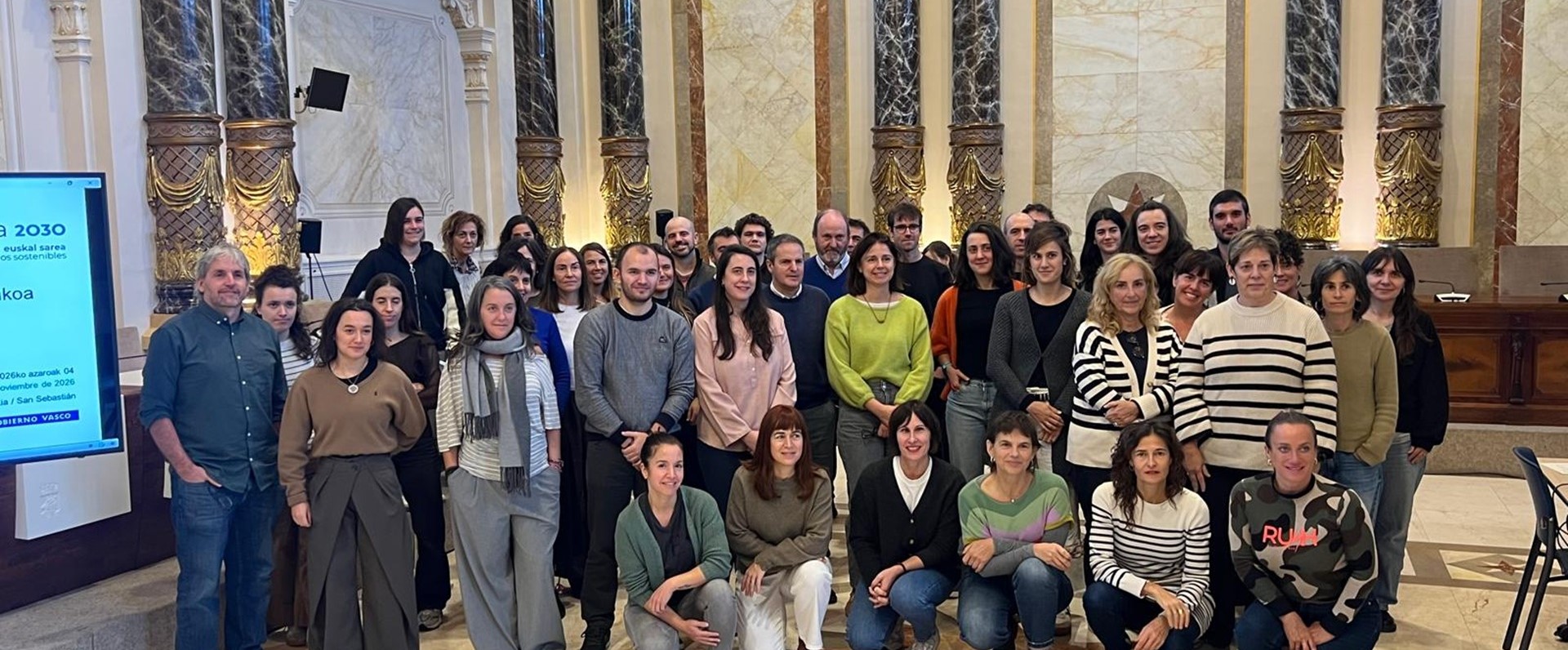
Following a welcome address by Sergio Fernández, the city council’s Director of Health and the Environment, the activity report for the first half of 2026 was presented; this can be viewed on the Udalsarea 2030 website. Among other aspects, the technical session on waste charges based on a pay-as-you-generate model, held in July, and its main conclusions were highlighted, as was the workshop last October to review the draft by-law regulating the waste collection service. The timetable for updating GHG tools and making municipal data available was also presented.
The first part of the morning’s programme focused on the energy transition. Mª Mar Alonso, Director of Climate Action at Ihobe, provided context on the obligations set out in Law 1/2024 on Energy Transition and Climate Change in relation to local authorities, as well as the instruments it provides for, such as the creation of the Basque Office for Energy Transition and Climate Change (OVTECC). Alonso highlighted the need for local authorities to provide information so that compliance with the obligation to draw up Climate and Energy Plans by local authorities with more than 5,000 inhabitants can be monitored.
It has been emphasised that local authorities must provide information so that compliance with the obligation to draw up Climate and Energy Plans by those with more than 5,000 inhabitants can be monitored.
She also shared the challenges identified during the meetings held by the OVTECC with the three Basque capitals, highlighting the integration and monitoring of the various plans currently in place across the municipalities, the energy-efficient refurbishment of buildings, and the shortage of specialist staff. However, it has been proved that adaptation is being tackled through nature-based solutions, and that the three capitals can act as leading and demonstration municipalities, providing lessons that can be transferred to other local authorities.Blanca Delgado, from the Basque Energy Agency, then outlined the main challenges facing local authorities in meeting the obligations set out in Law 4/2019 on Energy Sustainability. An interactive session with the attendees helped to identify difficulties: although 80 per cent of the local authorities present have an energy consumption inventory, many encounter problems in carrying out their annual monitoring and reporting. Regarding the challenges of the energy transition across the municipality, building refurbishment and a lack of funding stand out as the main obstacles, alongside mobility and the reduction of energy consumption.
The first session continued with a presentation by Jon Gastañares, the energy sustainability officer at the Department of Health and the Environment, on the challenges facing Donostia/San Sebastián City Council on the path towards the energy transition. He examined nearly two decades of the city’s efforts through various plans and strategies. Among the main current challenges, Gastañares stated that these include aspects such as governance, data management and monitoring; the energy-efficient refurbishment of buildings; and the development of renewable energy. Difficulties continue to include monitoring plans and data collection, as well as integrating information from different departments and the lack of automation for monitoring. In terms of needs, Gastañares highlighted the need for coordination between administrations and institutional feedback on the information provided and gave various examples where these challenges have arisen.
Fifth-generation heating and cooling networks are a viable option for the decarbonisation of buildings.
To close the first session of the day, Iñigo Arrizabalaga from Telur (an EVE subsidiary) presented the development of district heating networks as part of the decarbonisation of the building stock. The large number of buildings in the Basque Country (around 96 per cent) were built before 2010, which makes it difficult to tackle decarbonisation on a building-by-building basis. For this reason, Arrizabalaga presented fifth-generation heating and cooling networks as a viable option. Furthermore, he shared a study carried out in the Durangaldea region, which concluded that natural gas consumption would be reduced whilst thermal energy production would increase. Compared with other solutions, such as biomass or aerothermal energy, factors such as CO2 emissions are also reduced, and the financial investment required is lower.Climate change and adaptation: the second major area
The second part of the day was focused on climate change and adaptation. In this regard, this year’s major event will take place on 24 and 25 November with ADAPT AKTION, the forum on climate change adaptation solutions, which will bring the European LIFE IP Urban Klima 2050 project to a close. As well as marking the end of seven years’ work, the event will serve to set out the agenda for the next decade of climate adaptation in the Basque Country. Registration is now open.
This new decade of adaptation includes a new LIFE project that has been proposed to operate at a regional level: LIFE NaturSarea. Six regional demonstration projects on climate adaptation and landscape transformation have been proposed, comprising 14 strategic ‘SbN’ projects, coordinated under a multi-level governance model centred on the potential of regional bodies as drivers of local climate action, in the context of Udalsarea 2030.
LIFE NaturSarea proposes six regional demonstration schemes for climate adaptation and landscape transformation through 14 strategic SbN projects, coordinated under a multi-level governance model that focuses on the potential of regional bodies as driving forces.
In order to present the project, preliminary work was carried out with the local authorities involved, who have highlighted the support and guidance provided by US2030 throughout the preparation process. This support has been crucial in facilitating their participation and enabling them to tackle a call for proposals of this nature, which they would have found difficult to manage without this support network and an organisation to drive and coordinate the process.Furthermore, Mª Mar Alonso spoke about enhancing the SECAPs: “We believe it is a good idea to look within your plans to see which projects have not been implemented and to seek funding, or to see how other local councils have resolved those same issues.” She also encouraged the creation of a “portfolio of projects” for when funding opportunities arise, as was the case with the LIFE programme, since “without projects, it would not have been possible to prepare the proposal”.
To conclude this section, the topic of the importance of keeping track of the SECAPs that local authorities are implementing or have implemented was revisited. “The aim is to see how we at Udalsarea 2030 can help and to explore existing funding options, as well as to compile a catalogue that can serve as inspiration for other local authorities,” explained Agate Goyarrola, technical secretary of Udalsarea 2030. The service offered by Udalsarea 2030 to promote adaptation measures was also outlined, including, amongst other aspects, an analysis of current plans.
"The aim is to see how we can help through Udalsarea 2030 and explore the available funding options, as well as to produce a catalogue that will serve as inspiration for other local authorities."
Those attending took part in a self-assessment exercise of their plans, based on the criteria set out in the Udalsarea 2030 guide to drawing up local climate and energy plans, as a starting point for understanding how mitigation, adaptation, governance and monitoring are addressed. The aim is to identify gaps and challenges in the actions relating to climate change adaptation within these plans, so as to guide the support provided by Udalsarea 2030 and facilitate the implementation of new projects.
Several local authorities have now shared their experiences of drawing up and evaluating their SECAPs; this exchange of experiences enriches the debate and turns forums such as the technical committee meeting into valuable opportunities for sharing lessons learnt, comparing approaches and continuing to make progress on local energy and climate planning.
Lastly, a live survey has helped to identify the main needs of local authorities in relation to climate change adaptation. The lack of data and resources were highlighted as key obstacles to planning adaptation measures. As regards the support they expect from Udalsarea 2030, they particularly emphasised funding, technical advice, coordination between administrations and assistance in driving projects forward. In this regard, it was noted that the deadline for applying for grants aimed at promoting sustainable development in local authorities remains open until 30 November, with a total budget of 2.5 million euros for climate change, 1.4 million for natural heritage and 100,000 euros for Asteklima 2026.
The Technical Working Group has once again served as a means of providing local authorities with the latest news, regulations, resources and tools relating to the network’s priority areas, as well as of gathering their input, needs and experiences. This enables the network’s work to be tailored so that it is of genuine use and support to Basque local authorities.